
It is the silence that wakes people, not the dark.
The refrigerator compressor stops. The furnace blower winds down. That faint electrical hum a house makes all day, the one nobody can hear until it is gone, goes out. Somebody lies there for a few seconds working out what actually changed.
Then the practical questions arrive, roughly in order of what they are going to cost. How cold is it going to get in here. Is the sump running. What is in the freezer. At what point does a well stop being a well and start being a hole in the ground with a dead pump at the bottom of it.
A whole house battery backup system keeps a predetermined set of circuits running when the utility fails, transferring fast enough that most equipment in the house never registers the interruption. The phrase doing the work in that sentence is predetermined set of circuits, and almost everything that goes wrong with backup power goes wrong because nobody wrote that list down early enough.
QAV frames this work in three verbs, generate, store and protect. This piece is about the third one, which is the only reason the first two matter at two in the morning.
Start with the good news, because it is better than most people expect.
The Sol-Ark 12K-2P-N inverter at the center of a HelioWing system transfers from grid tied to off grid operation in four milliseconds. Not four seconds. Four thousandths of a second.
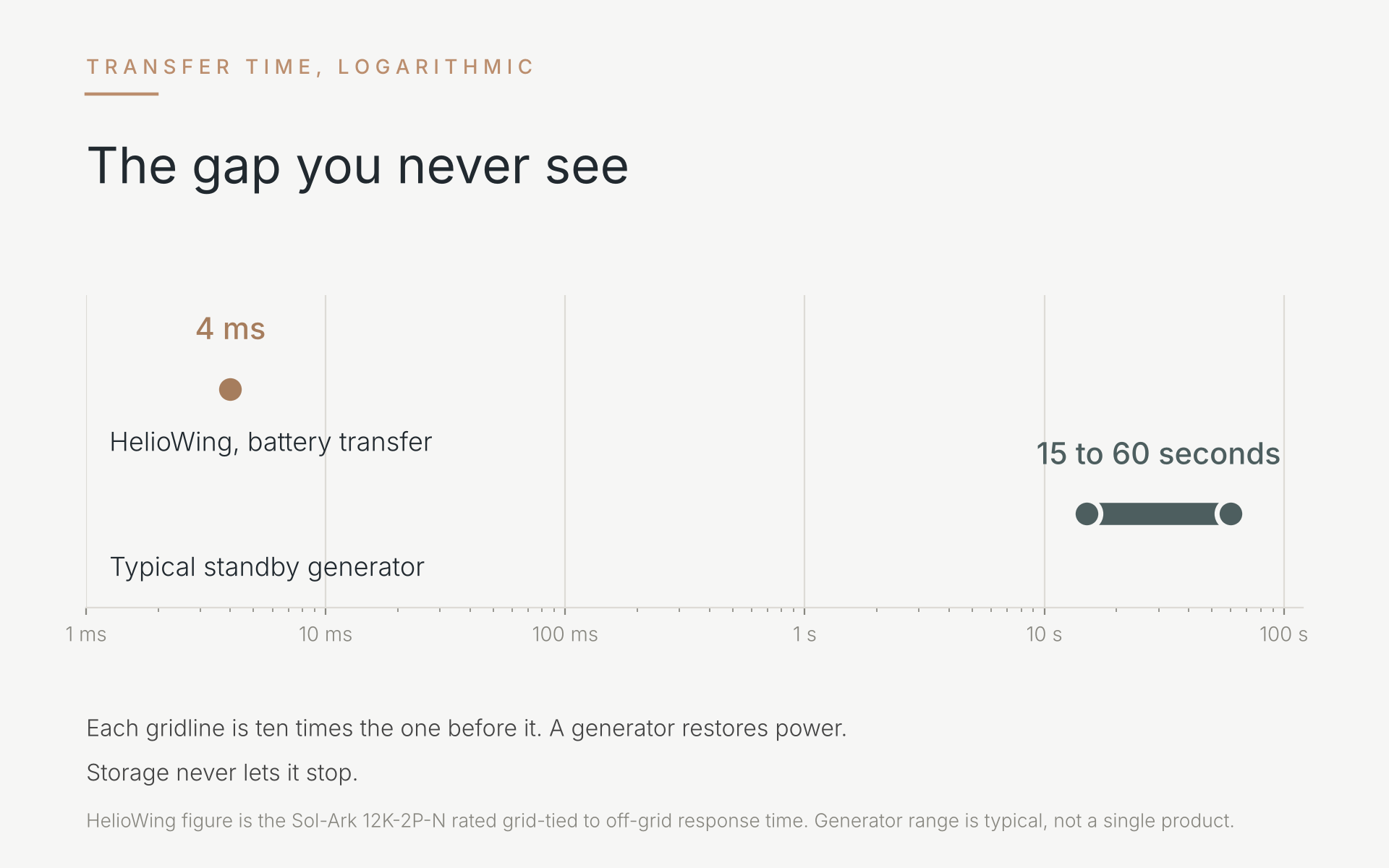
That number matters more than it looks. A generator needs to crank, start, stabilize and then accept load, which is why a generator house experiences an outage as a gap, somewhere between fifteen seconds and a minute of darkness followed by the lights coming back. A four millisecond transfer is below the threshold at which a filament would visibly dim, and far below the point at which a computer, a router, a network switch, a security panel or a media server would drop out and reboot.
The practical consequence is that nobody loses a video call. Nobody loses whatever they were working on. The cameras never stop recording, which matters, because losing power and losing visibility of the property at the same moment is how an inconvenient night becomes a genuinely bad one.
You find out the next morning, from a neighbor, that the street was dark for six hours.
Here is the part the brochures move past quickly.
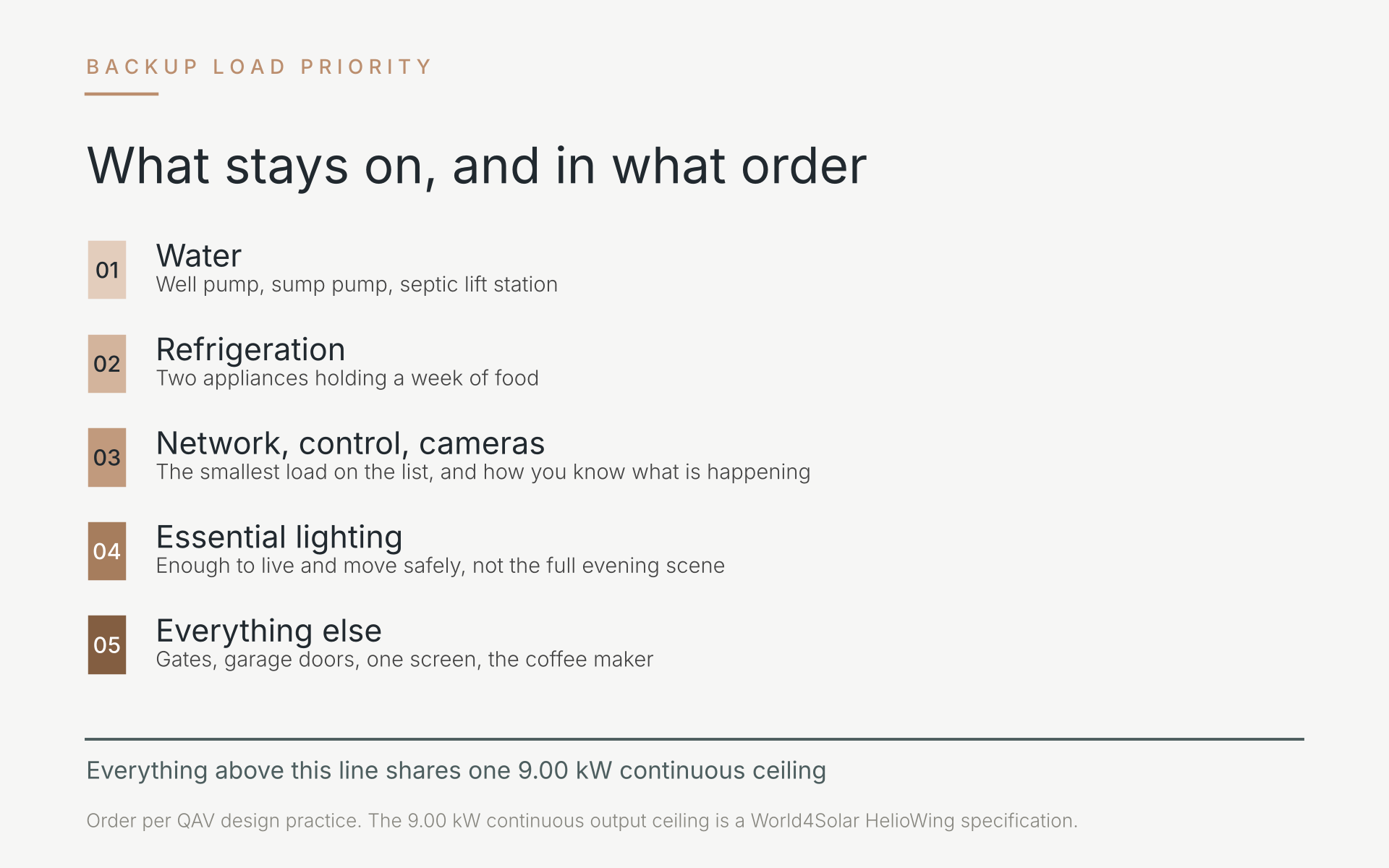
Continuous AC output is 9.00 kilowatts. There is surge capacity above that, 16,000 volt amperes for ten seconds and 25,000 for a hundred milliseconds, which exists to cover the inrush when a well pump or a compressor starts. But the number you design against is nine kilowatts, continuous.
Nine kilowatts is a great deal of electricity and it is nowhere near a large house running normally. A single electric range element and an electric dryer can approach it between them. Resistance heat will exceed it on its own.
So the design question is not how big a battery do I need. It is what am I unwilling to lose, and then what is the running total of those things, and does that total fit under nine kilowatts with the surge headroom to start the biggest motor on the list.
That is an arithmetic problem with a definite answer, and it is the most useful hour anybody spends on an energy project.
Owners resist this conversation because it requires admitting that something will be off. It is worth having anyway, because the alternative is a battery that discovers its own priorities at two in the morning.
Water first. The well pump and the sump pump, always, and ahead of everything else. Water moving the wrong way, or not moving at all, ruins a house faster than anything else on this list and the damage does not reverse when the power returns. A septic lift station belongs in the same tier for the same reason.
Refrigeration second. Not for comfort. For the contents of two appliances that quietly represent real money and a week of inconvenience.
Network, control and cameras third. The network is not a luxury during an outage, it is how you know what is happening, how the automation keeps doing its job, and how anyone reaches you. It also happens to be among the smallest loads in the house, which makes it the best value on the entire list.
Lighting fourth, and less than people think. Enough to live normally and move safely, not the full evening scene.
Then, with whatever capacity is left, the rest. Garage doors. A gate. One television. The coffee maker, because morale during a three day outage is a real engineering input and anyone who has lived through one knows it.
Colorado makes this question unavoidable, and the three answers are very different from one another.
Electric resistance heat is effectively incompatible with battery backup. The physics does not negotiate. A resistance system will drain a large battery bank in a few hours and there is no clever configuration that changes it.
A heat pump is dramatically better, because it moves heat rather than making it, and a well chosen cold climate unit can be carried on backup for a meaningful stretch.
And a gas furnace, which sounds like the least modern answer, is often the best one available. The burner needs no electricity from your battery. Only the blower does, and a blower is a small, steady load delivering a very large amount of comfort. A gas furnace on backup is one of the highest returns per watt in the entire house.
This is the kind of finding that should influence mechanical selection rather than arrive after it, which is why the energy conversation belongs in schematic design rather than at the end.
Everything above resolves into one piece of hardware and one drawing.
The hardware is a critical loads subpanel. The circuits that stay alive during an outage are the circuits physically landed in that panel, which means somebody has to decide which circuits those are while the electrician is still pulling wire, and route them accordingly.
Do it then and it costs nothing beyond a panel and a plan. Do it later and an electrician is tracing finished circuits, re routing them through finished walls, and patching, texturing and repainting behind the work. The cable is cheap. The drywall is not. We make the same argument about everything else that hides inside a wall, and backup power is the clearest example of it in the house.
The classic failure is not a dramatic one. It is a house where the battery works perfectly and carries the hallway lights and the guest bedroom, while the well pump sits on the main panel, dead, because nobody ever wrote the list.
There is a circularity worth naming here. In Colorado the thing that takes the power out is frequently the same thing that attacks whatever you installed to replace it.
On the sixth and seventh of April 2024, gusts along the Front Range topped 100 miles an hour and more than 150,000 people across nine counties lost power. Roughly 55,000 of those outages were deliberate, switched off by the utility to keep its own lines from starting a fire. We covered that distinction and why it changes restoration time in the broader piece on energy independence and preparedness.
What matters here is whether the equipment is rated for the weather that caused the problem. The HelioWing is engineered to IBC 2018 and ASCE 7-16, with standard structural loads of 150 mile per hour wind at zero ground snow load, or 120 mile per hour wind at 50 pounds per square foot of ground snow. Seismic Category D. The panels themselves carry 5,400 pascals of both snow and wind load, and the structure is US made high strength steel, robotically welded in an ISO 9001 and AISC certified facility.
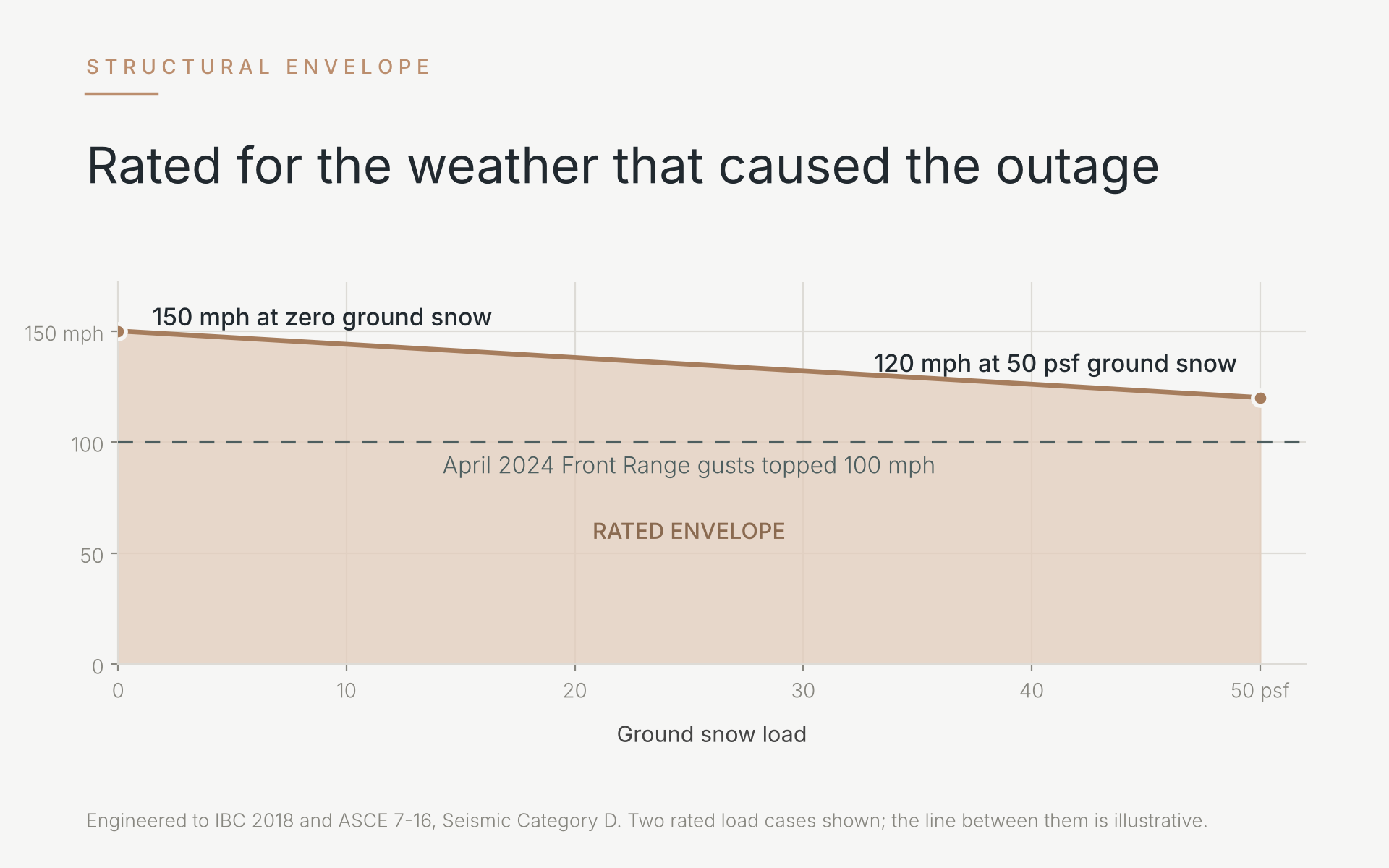
A canopy rated to 120 miles an hour with half a hundredweight of snow on it, in a state where the outage event itself ran at 100, is the right order of margin. Backup equipment that cannot survive the conditions that created the outage is not backup equipment.
One specification deserves to be read before purchase rather than discovered in January.
The battery discharges down to minus 25 degrees Celsius, which is minus 13 Fahrenheit. It will not accept charge below minus 15 Celsius, which is 5 degrees Fahrenheit. The pack includes electric heating to manage low temperatures, and that heating draws power of its own.
In a multi day winter outage this is the specification that bites, because it is the one case where the battery can be discharging and unable to refill even with sun on the array. It is a siting problem rather than a dealbreaker. Equipment belongs in conditioned or sheltered space. A battery in an unheated outbuilding at altitude will spend part of every winter unable to do half its job.
A battery and a generator are usually presented as a choice. The equipment itself does not see it that way.
The HelioWing supports four installation modes, and one of them is single unit, off grid with generator. Storage handles the instant transfer, the quiet hours, the overnight and the ordinary two hour interruption that represents the overwhelming majority of outages. An engine, when one is present, handles the long tail: the fourth consecutive overcast day, the week when the road is closed, the stretch below 5 degrees when the battery cannot refill itself.
Each covers the other's weakness, and the combination is a legitimate design rather than a compromise. If you are weighing the two against each other, we wrote that comparison up separately in how a battery and a generator differ in the moment it matters.
Backup power fails at the handoffs, the same as every other system in a house.
The panel was full before anyone asked about a subpanel. The conduit path from canopy to equipment room was never roughed in, so it now runs on the outside of a wall somebody chose carefully. The automation was never told what to do when the grid drops, so nothing dims, nothing sheds, and the battery spends its first hour on loads nobody would have chosen.
QAV designs energy alongside lighting, shades, network and control rather than as a separate trade arriving late. Under Done at Closing the system is built and tested in our own facility before it reaches the house, which on an energy system means the transfer and the load shed sequence are proven on a bench rather than during the first real outage. SUSTAIN is the pillar this work sits in.
Twenty years and more than 700 Colorado homes is mostly an education in which handoffs break. QAV is HTA Certified at the Estate Level, in the top one percent of integrators in North America.
QAV is also the exclusive World4Solar dealer in Colorado, which makes the QAV Experience Center in Centennial the only place in the state to stand under a HelioWing before you own one. Visits are by appointment.
And if what you want is not certainty on the worst night but a house that runs on what the property makes every ordinary day, that is the other fork, and it is written up in what it actually takes to go off grid in Colorado.

The Sol-Ark 12K-2P-N inverter used in a HelioWing system transfers from grid tied to off grid operation in four milliseconds. That is fast enough that a filament would not visibly dim and far below the interruption required to make a computer, router, network switch, security panel or media server drop out and restart. A generator behaves differently, because it has to crank, start, stabilize and then accept load, which is why a generator house experiences an outage as a gap of roughly fifteen seconds to a minute.
Continuous AC output is 9.00 kilowatts, with surge capacity of 16,000 volt amperes for ten seconds and 25,000 volt amperes for one hundred milliseconds to cover motor inrush when a well pump or compressor starts. Nine kilowatts continuous is substantial but well short of a large house running normally, since an electric range element and an electric dryer together can approach it. This ceiling, not battery capacity alone, is what determines which loads can run at the same time.
A critical loads panel is a subpanel holding the circuits that stay energized during an outage. Only circuits physically landed in that panel are backed up, so the decision has to be made while the electrician is still pulling wire and routing circuits. Decided before drywall it costs a panel and a plan. Decided afterward it requires tracing finished circuits, rerouting them through finished walls, and then patching, texturing and repainting behind the work.
Water first: the well pump, the sump pump and any septic lift station, because water moving the wrong way or not moving at all causes damage that does not reverse when power returns. Refrigeration second. Network, control and cameras third, since these are among the smallest loads in the house and they are how anyone knows what is happening on the property. Essential lighting fourth. Heat is a separate decision, because electric resistance heat is effectively incompatible with battery backup, a heat pump is far more efficient, and a gas furnace needs battery power only for its blower.
The HelioWing is engineered to IBC 2018 and ASCE 7-16, with standard structural loads of 150 mile per hour wind at zero ground snow load, or 120 mile per hour wind at 50 pounds per square foot of ground snow. It is rated Seismic Category D, and the Aptos bifacial modules carry 5,400 pascals of both snow and wind load. For context, gusts during the April 2024 Front Range wind event topped 100 miles per hour.
Yes. The HelioWing supports four installation modes and one of them is a single unit off grid with a generator. In that arrangement storage handles the instant transfer, the overnight hours and the ordinary short interruption that represents most outages, while the engine covers the long tail such as a fourth consecutive overcast day or a stretch below 5 degrees Fahrenheit when the battery cannot accept charge. The two cover each other's weaknesses rather than competing.