Two people call about the same system, and they could not sound less alike.
The first has been thinking about it for years. They drive something electric, they have opinions about where their power comes from, and they would like the house to carry its own weight. The word they use is independence.
The second one calls on a Tuesday in April, the morning after the wind took the power out for thirty hours. The sump pump stopped. The freezer thawed. The word they use is not independence. The word they use is again, as in, I am not doing that again.
One is building toward something. The other is running from something. They specify nearly identical hardware.
Home energy independence is the ability of a house to generate its own electricity, store enough of it to matter, and run on that stored power when the utility is unavailable. It takes three parts working together, and most homes buy only the first one.
A house with a roof full of solar panels and no battery goes dark in a blackout. Not occasionally. Every time, including at two in the afternoon in full sun with every panel producing.
That is not a defect, and it is not a brand problem. It is a requirement. Grid tied inverters are built to sense the loss of utility power and disconnect within seconds, under IEEE 1547 and UL 1741. The term is anti islanding. The reason is a lineworker somewhere down the road with their hands on a conductor they have every right to believe is dead. Your array is not permitted to energize that line, so the moment the grid drops, your array stops.
Which is how an owner ends up standing in a dark kitchen, looking out at a roof in bright sunshine, learning something they should have been told in the first conversation.
Solar is a generation decision. Resilience is a storage decision. They get sold in the same breath and they are not the same purchase.
The two callers want different things, and it is worth naming the difference honestly, because it changes what gets designed.
The independence client is optimizing for ordinary days. They want the house to run on what it made, they want the car charged by the roof rather than the meter, and they want the whole arrangement to look deliberate rather than improvised. Their system is sized around daily production and daily use. Outages are a bonus.
The preparedness client is optimizing for the worst week of the year. They do not much care what happens in June. They care what happens when the line is down, the road is closed, and nobody can tell them when it will end. Their system is sized around a defined set of loads carried for a defined number of days.
Those two briefs pull in different directions. The first wants generation. The second wants storage. Build only for one and the other disappoints, which is why so many houses have an impressive array and no answer at all on the night it matters.
The useful conversation starts by asking which caller you actually are, and then admitting you are probably a little of both.
Both roads are worth walking properly, and each has its own piece here. If you are the first caller, optimizing ordinary days, read what it actually takes to run a Colorado house off the grid. If you are the second, optimizing the worst night of the year, read how to design a house that does not notice an outage. Read whichever sounds like you first, and the other one second.
The average American customer went without power for about five and a half hours across 2022, the most recent year in the federal reporting at the time of writing. On its own that sounds survivable, and it is.
The number underneath it is the interesting one. Strip out major events and interruption time has sat at roughly two hours a year since 2013, essentially flat. Nearly all the movement, year over year, comes from major events. The ordinary grid is about as good as it was a decade ago. The extraordinary grid is where the hours now live, and extraordinary days are not distributed evenly across the country.
Colorado knows this better than most. On the sixth and seventh of April 2024, more than 150,000 people across nine counties lost power. Gusts topped 100 miles an hour. Roughly 55,000 of those outages were not caused by the wind at all. The utility switched them off deliberately, to keep its own lines from starting a fire.
That is a different category of event, and it is the one worth designing around. A storm outage ends when the storm does. A public safety power shutoff ends when a crew has physically driven and inspected the line, which is exactly why restoration ran long that weekend. Circuits that would normally re energize themselves had to be walked first.
You cannot harden your way out of that one. The utility is going to do it again, on purpose, on the days the forecast tells them to. The only household answer is to not need them for a while. We have written separately about how a battery and a generator differ in that moment, because they are not interchangeable.
Three verbs, and the order matters. It is how QAV frames the SUSTAIN pillar, and World4Solar arrives at nearly the same place describing what the HelioWing canopy actually does.
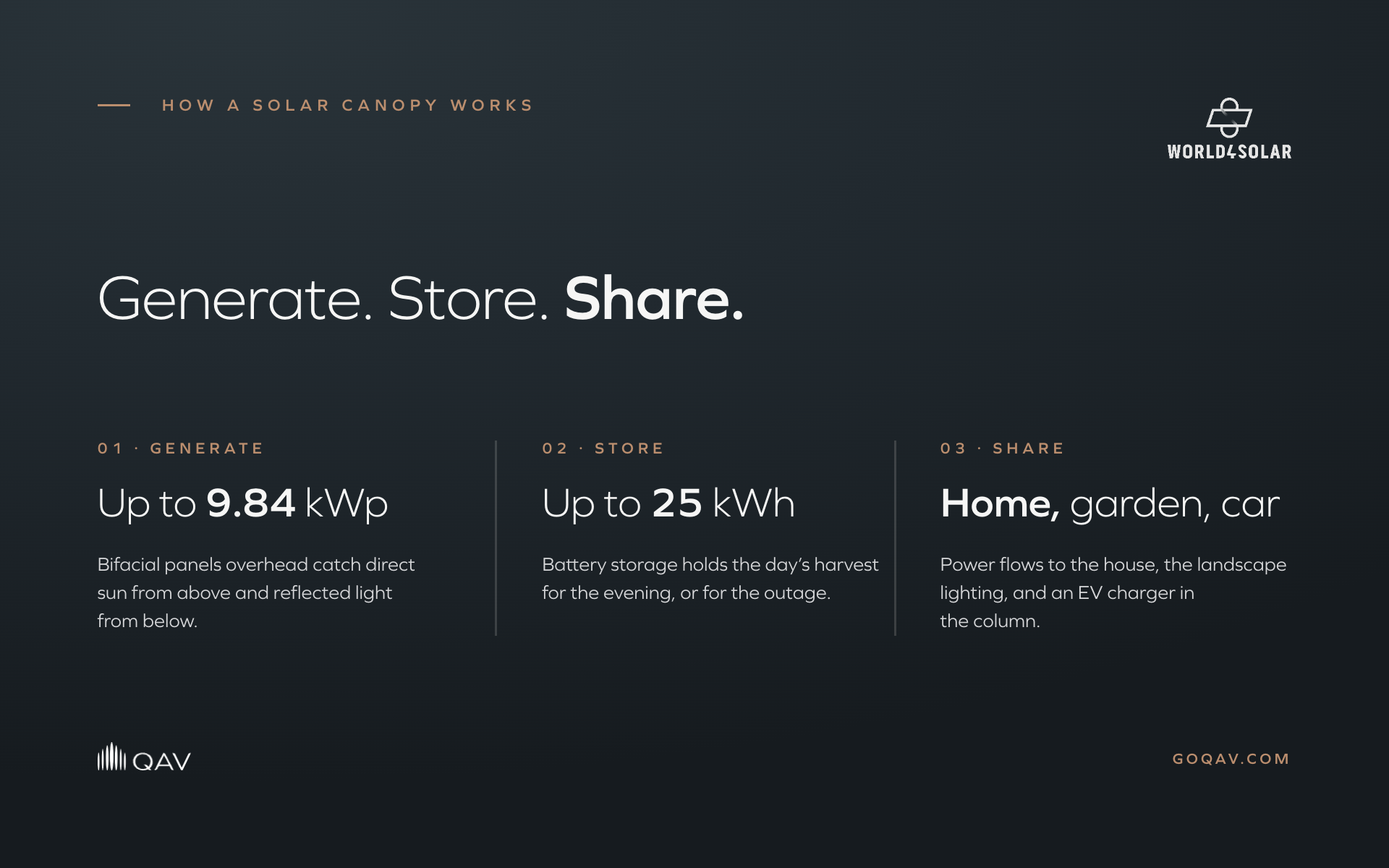
Generate. Bifacial panels collect direct sun on the upper face and reflected light on the lower one, which is a quiet advantage in a state that spends several months a year with the ground painted white. Fresh snow is one of the most reflective surfaces in ordinary life. An array that can use the bounce is working on days a conventional one is merely enduring.
Store. Storage is what converts generation into resilience. Without it you have a daytime appliance. With it you have a house that does not care what the utility is doing. This is the component people skip, and it is the only component that changes the experience of an outage.
Protect. Power that leaves the battery has a job, and it is not decoration. It keeps the well pumping and the sump running. It keeps the network up, so the house stays reachable and the cameras keep watching. It keeps the car charged and the drive lit. On the HelioWing the charger lives inside the structural column, which means it is part of the building rather than a box bolted to a garage wall.
Most residential solar goes on the roof because the roof is already there. That is the whole argument for it, and on plenty of houses it is a good enough one.
It stops being good enough in a few specific situations. The roof faces the wrong way, because the architect oriented it to the view rather than the sun. The roof is slate, or standing seam, or a warrantied membrane nobody wants to penetrate. The roof is shaded by the mature trees that are half the reason you bought the property. Or the roof is simply the most visible plane on a house whose entire design argument is restraint, and an array laid across it reads as equipment.
A canopy answers all four, because it is sited where the sun is rather than where the roof happens to be. It also does a second job, which is the part that makes it architecture instead of infrastructure. It shades a terrace. It defines an outdoor room. It carries lighting. It puts the car charger in a column where the car already parks.
The canopy QAV builds these systems around is the HelioWing, made by World4Solar. It comes in two sizes.
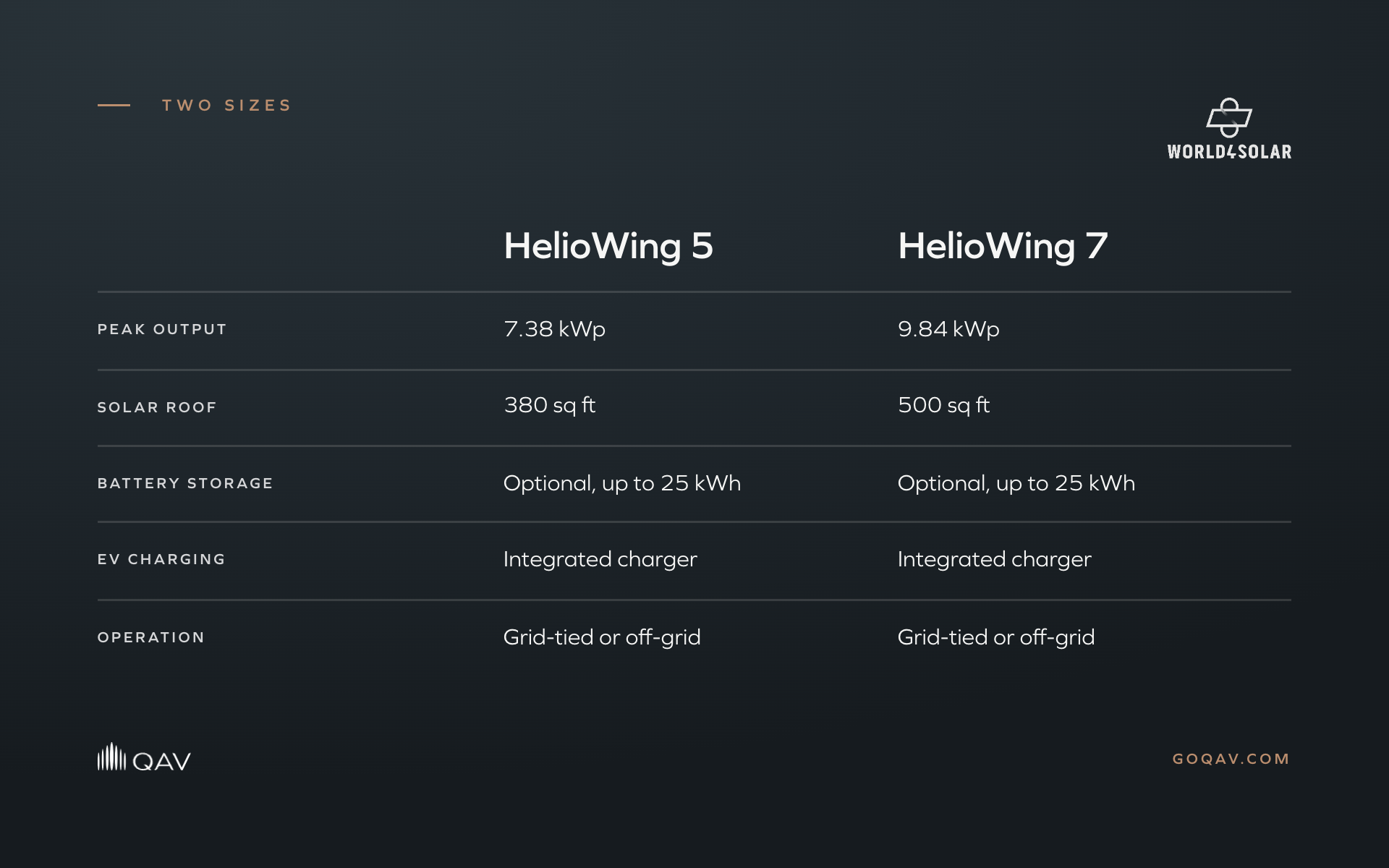
The HelioWing 5 carries roughly 380 square feet of solar roof and peaks near 7.38 kilowatts. The HelioWing 7 carries roughly 500 square feet and peaks near 9.84 kilowatts. Both accept optional battery storage up to 25 kilowatt hours, both include the integrated charger in the column, and both run grid tied or fully off grid.
QAV is the exclusive World4Solar dealer in Colorado. That sentence is worth one line of plain explanation, because exclusivity on its own is just a claim. What it means practically is that the QAV Experience Center in Centennial is the only place in the state where you can walk under a HelioWing before you own one.
That turns out to matter more than it sounds. Specifications do not tell you how much light reaches the terrace underneath, or how the wing reads against a sky at dusk, or whether the column lands where you would actually want to park. They do not tell you how quiet it is. Every one of those questions is answered in about ninety seconds of standing under one, and not at all by a drawing.
Here is the part most of this category will not tell you plainly.
A battery does not power a house. It powers the loads you decided, in advance, that it would power. The design question is not how big a battery do I need, it is what am I unwilling to lose, and the answer is almost never everything.
The honest hierarchy runs roughly like this. The well pump and the sump pump, because water moving the wrong way ruins a house faster than anything else on this list. The refrigeration. The network and the cameras, because losing the grid and losing contact with the property at the same time is how a bad week becomes a worse one. Enough lighting to live normally. Then, if you have the capacity, the rest.
Heat is where Colorado gets difficult. Electric resistance heat will empty a battery in hours and there is no clever way around the physics. A heat pump is dramatically better. A gas furnace, counterintuitively, is one of the easiest wins available, because the burner does not need your battery, only the blower does, and a blower is a small load carrying a very large comfort.
Then there is the seasonal mismatch, which nobody enjoys discussing. Your shortest days and your highest loads arrive in the same eight weeks. A system sized against an annual average will feel heroic in June and thin in late December. Sizing for genuine independence means sizing for the worst week rather than the typical one, which costs capacity in both directions.
Full, permanent, no utility connection independence is achievable in Colorado. It is also a different project from the one most people are imagining, and it usually involves accepting a few constraints on how the house behaves. Anyone who tells you a single battery runs a large home indefinitely is selling something, and it is not engineering.
The state is unusually good at this and unusually demanding about it at the same time.
The sun is the easy part. Colorado gets a great deal of it, the air is thin, and high altitude arrays see strong irradiance. Cold is good for panel efficiency. Snow on the ground helps a bifacial array rather than hurting it, provided the panels themselves can shed.
The demanding parts are specific and local. Wildfire season now carries a deliberate shutoff risk that has nothing to do with whether your own power lines survived. Mountain properties often sit at the thin end of a long utility run, which is the first thing to fail and the last thing to be restored. Batteries want conditioned space rather than an unheated garage at nine thousand feet. And a property with a detached shop, a gate, a guest house, or a well is a property where losing power costs more than a dark living room.
All of which is to say the generic answer is usually the wrong one here. The right system in Cherry Hills Village and the right system above Evergreen are not the same system.
Energy fails the same way every other system in a house fails, which is at the handoff.
The panel was full before anyone asked about a subpanel. The circuits that needed to be on backup were never identified, so the battery carries the hallway lights and not the well. The conduit path from the array to the equipment room was never roughed in, so it runs on the outside of the building. The automation was never told what to do when the grid drops, so nothing dims, nothing sheds, and the battery spends its first hour on loads nobody would have chosen.
Every one of those is a decision that costs nothing while the walls are open and a great deal afterward, which is the same argument we make about everything else that hides inside a wall.
QAV designs energy alongside lighting, shades, network and control rather than as a separate trade arriving late. That is also the reason we carry World4Solar rather than treating solar as somebody else's scope. Under Done at Closing a system is built and tested in our own facility before it reaches the house, which on an energy system means the load shed behavior and the transfer are proven on a bench rather than discovered during the first real outage. SUSTAIN is the pillar this work sits in.
Twenty years and more than 700 Colorado homes is mostly an education in which handoffs break. QAV is HTA Certified at the Estate Level, in the top one percent of integrators in North America.
The lights do not dip.
The transfer takes four milliseconds, which is faster than a filament can cool and far below anything a person or a piece of equipment registers. Nobody announces anything. The movie keeps playing. The router never rebooted, so nobody lost a call. The well pump runs when someone turns a tap. Somewhere outside, a canopy that spent the day making power is quietly giving it back, and the house behaves exactly as it did an hour ago.
You find out the next morning, from a neighbor, that the power was off for most of the night.
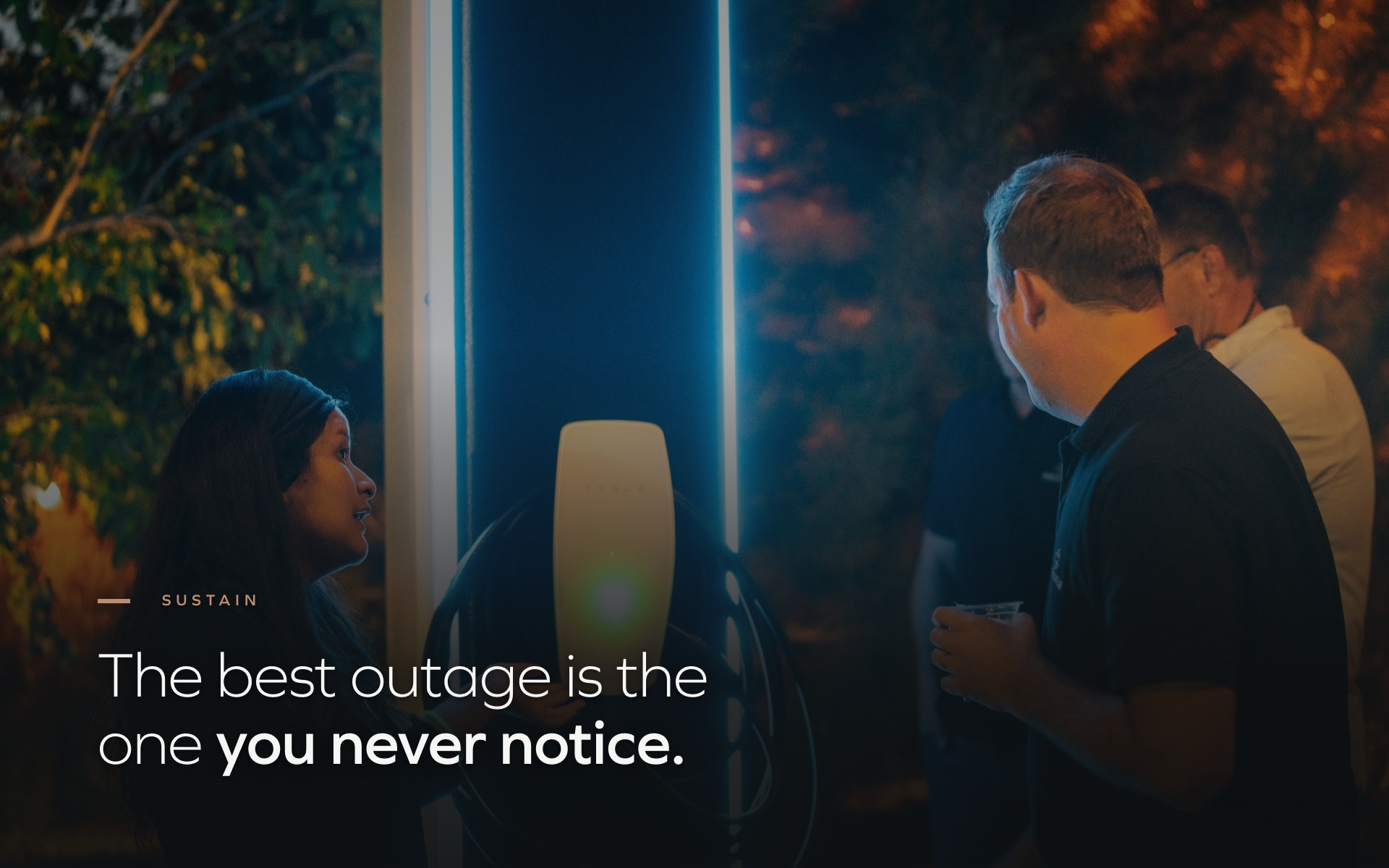
That is a hard thing to believe from a page and an easy thing to understand standing under a HelioWing at dusk, with the charger lit and the terrace in shade. The QAV Experience Center in Centennial is the only place in Colorado to do that, and it is open by appointment.

No. A grid tied solar array without battery storage shuts down during a power outage, even in full sunlight. Grid tied inverters are required under IEEE 1547 and UL 1741 to detect the loss of utility power and disconnect within seconds, a behavior called anti islanding, so that the array cannot send electricity onto lines that utility crews are working on. Battery storage, paired with equipment that can safely disconnect the house from the grid, is what allows a solar home to keep running during an outage.
Battery storage requirements depend entirely on which loads the battery is asked to carry, because a home battery powers a selected set of circuits rather than an entire house by default. A typical priority order is the well pump and sump pump first, then refrigeration, then the network and cameras, then essential lighting. Electric resistance heat consumes battery capacity very quickly, a heat pump is far more efficient, and a gas furnace needs battery power only for its blower rather than for heating itself.
Yes, though it is a more demanding project than most homeowners expect. Permanent off grid operation requires sizing generation and storage against the worst week of the year rather than the annual average, because the shortest days and the highest heating loads arrive at the same time in winter. It also usually requires accepting some constraints on how the house behaves during extended low production periods. A single battery cannot run a large home indefinitely.
A public safety power shutoff is a deliberate de energization of power lines by a utility during high fire risk conditions, carried out to prevent the lines from igniting a wildfire. During the April 6 and 7, 2024 wind event in Colorado, more than 150,000 people across nine counties lost power and roughly 55,000 of those outages were intentional shutoffs rather than storm damage. Restoration takes longer than a storm outage because crews must physically inspect lines before re energizing them instead of allowing circuits to restore automatically.
The HelioWing is a solar canopy made by World4Solar that generates electricity from a freestanding structure rather than from panels mounted on a roof. The HelioWing 5 carries roughly 380 square feet of solar roof with a peak output near 7.38 kilowatts, and the HelioWing 7 carries roughly 500 square feet with a peak output near 9.84 kilowatts. Both accept optional battery storage up to 25 kilowatt hours, both include an electric vehicle charger integrated into the structural column, and both can operate grid tied or fully off grid. A canopy suits properties where the roof faces the wrong direction for sun, where the roof material should not be penetrated, where trees shade the roof, or where a roof array would visually dominate the architecture.
QAV is the exclusive World4Solar dealer in Colorado. The QAV Experience Center at 14697 E Easter Ave, Suite A in Centennial is the only location in the state where a HelioWing solar canopy can be seen and experienced in person before purchase, which allows questions about shading, scale, siting and column placement to be answered directly rather than from a drawing. Visits are by appointment.