The call comes with no urgency in it at all.
Nobody's power is out. Nothing has failed. The caller has been thinking about this for two or three years, has read considerably more than they needed to, and arrives with a question rather than a panic. They want to know whether the house can run on what the property makes. Not as a gesture. Actually run.
This is the harder of the two energy conversations, and it is the one with less honest material written about it. Outage preparedness has an obvious finish line, which is that the lights stay on. Independence does not. It is a target you approach by degrees, and the real work is deciding where on that curve you want to stop.
An off grid home generates all the electricity it uses, stores enough to carry the hours it is not generating, and is sized against its worst production week rather than its annual average. That last clause separates a system that works in February from one that works on a spreadsheet.
QAV frames this work in three verbs, generate, store and protect. What follows is about the first two. The third, what the house does on the night the grid fails, is its own article.
Most solar proposals are built around an annual figure. Your house uses so many kilowatt hours a year, the array makes so many, the two numbers meet, and the arithmetic looks like independence.
It is not independence. It is an average, and you cannot live inside an average.
A grid tied house with no battery does not care, because the utility quietly absorbs every mismatch between what the roof made at noon and what the house wanted at seven. Remove the utility and every one of those mismatches becomes yours to solve, hour by hour, in the actual weather.
So the design question changes. Not how much do we make in a year, but what is the worst consecutive stretch this property will see, and can we carry the house through it. In Colorado that stretch is usually four to six overcast days in December or January, arriving in the same weeks the house wants the most energy it will want all year.
Size against that and the system feels almost comically oversized in June. That surplus is not waste. It is the margin that makes January survivable, and it is also what charges the car without touching the meter for eight months of the year.
Bifacial panels collect light on both faces. The upper surface does the obvious work. The lower surface collects whatever the ground throws back.
Fresh snow is one of the most reflective surfaces in ordinary life, considerably brighter than grass, gravel or a paved driveway. An array that can use the bounce is gaining something on exactly the days a conventional roof array is struggling, which is a genuinely useful inversion in a state that spends a third of the year with a white ground.
Cold helps too. Photovoltaic cells are more efficient at low temperature, not less. The popular intuition that solar is a summer technology has it backwards on the efficiency question. What summer gives you is hours, not efficiency.
The HelioWing uses Aptos DNA-108-BF10 double glass bifacial modules, 410 watts each, rated to 5,400 pascals of snow load and the same again in wind. The HelioWing 5 carries eighteen of them across 384 square feet of solar roof for 7.38 kilowatts at peak. The HelioWing 7 carries twenty four across 512 square feet for 9.84 kilowatts. Both sit at a fixed ten degree inclination, which is shallow enough to look like architecture and steep enough to shed.
Everything else in a house is roughly fixed. The refrigerator runs. The well pump runs when someone opens a tap. You are not going to negotiate with your own furnace.
The car is different. An electric vehicle is both the biggest discretionary load on the property and the most flexible one, because it almost never needs to charge right now. It needs to be charged by morning. That difference is the single most valuable piece of headroom in an independent system, and it is the reason EV charging and energy independence belong in the same conversation rather than separate ones.
On the HelioWing the charger is a Tesla Gen 3 Wall Connector rated at 7.6 kilowatts, with a twenty four foot cable, and it lives inside the structural column rather than bolted to a garage wall. The column also carries LED strip lighting on motion sensors, which exists to guide you into the parking position in the dark and turns out to be one of those details nobody asks for and everybody mentions afterward.
The architectural argument matters here as much as the electrical one. A charger in a column that the car parks beside anyway is infrastructure that reads as part of the building. A charger screwed to siding reads as an appliance someone added later, because it is.
Storage on the HelioWing is modular, and the tiers are worth knowing because they are the lever you pull after the array is fixed.
One block gives 8.352 kilowatt hours. Two gives 16.704. Three, which is the maximum the structure accepts, gives 25.056. Each block pairs a Pylontech US3000C with a US5000, and the usable depth of discharge is 95 percent, which is high and means the nameplate is close to honest. Rated cycle life is more than 6,000 cycles at room temperature.
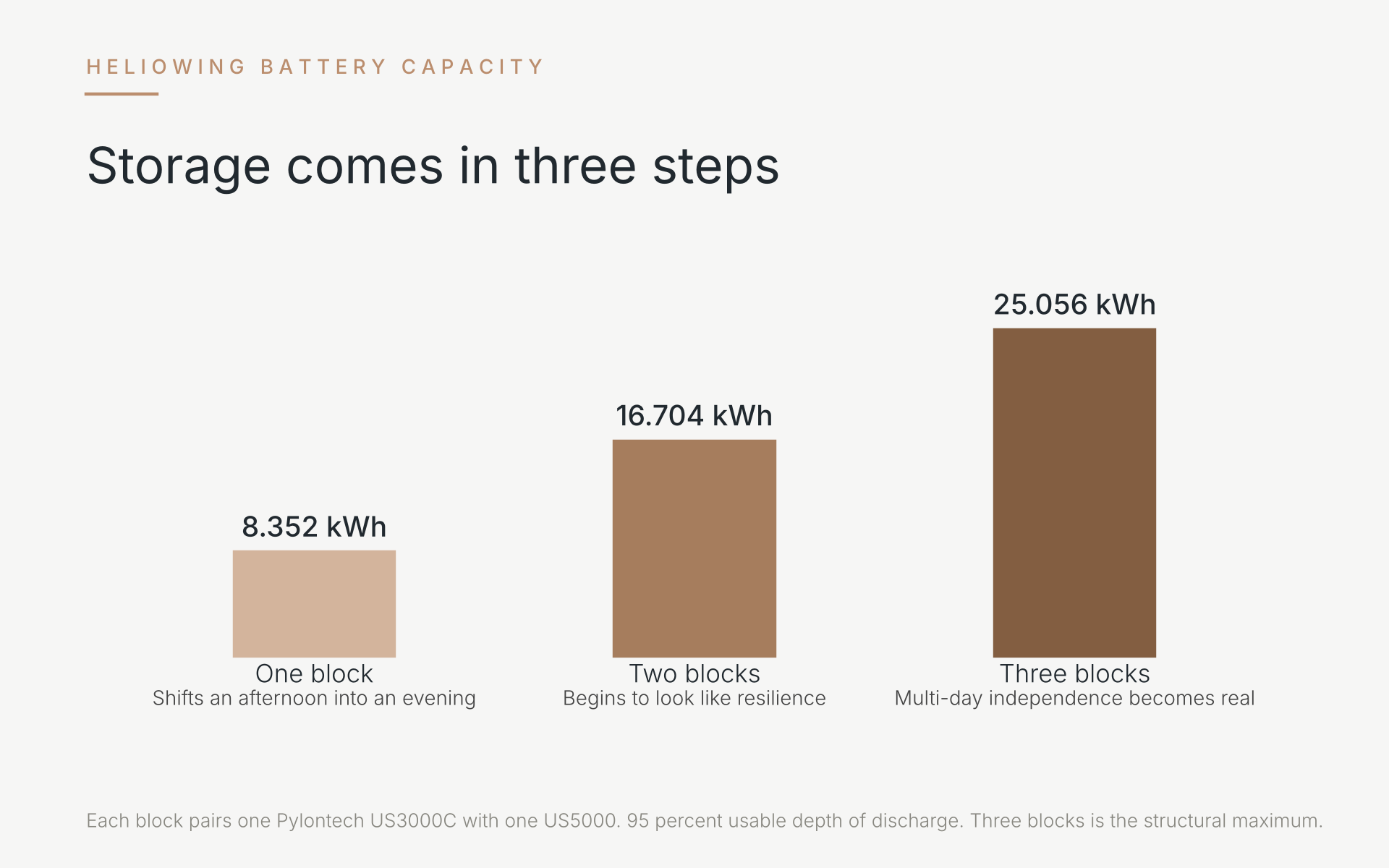
One block is a day shifter. It moves afternoon production into the evening and does that one job well. Two blocks begins to look like resilience. Three blocks, on the larger array, is where genuine multi day independence starts to be a real conversation rather than an aspiration.
And where several canopies are warranted, up to six units can run in parallel, which is how a property with a main house, a guest house, a shop and a well gets treated as one system instead of four arguments.
Your shortest days and your highest loads arrive in the same eight weeks. There is no equipment that fixes this. It is orbital.
What you can do is decide in advance which way you want to be wrong. Size for the annual average and the system will feel heroic in June and thin in late December, and the thin weeks are the ones you will remember. Size for the worst week and you buy capacity that spends most of the year unused, which feels wasteful right up until the week it does not.
Most owners who genuinely want independence land nearer the second option, and then recover some of that apparent waste by pointing the summer surplus at the car, the pool equipment, the shop, or whatever else on the property can happily consume cheap afternoon electricity.
Full, permanent, no utility connection independence is achievable in Colorado. It is also a different project from the one most people picture, and it usually involves accepting a few constraints on how the house behaves in the worst weeks. Anyone who tells you one battery runs a large home indefinitely is selling, and it is not engineering.
Here is the specification most of this category leaves out, and we would rather you read it here than discover it in February.
The system operates down to minus 25 degrees Celsius, which is minus 13 Fahrenheit. But below minus 15 Celsius, which is 5 degrees Fahrenheit, the battery will not charge. It will discharge. It will not accept charge. The pack carries electric heating specifically to manage this, and that heating draws power of its own, but the limit is real and in parts of this state it is reached several times a winter.
There is a derating threshold at the other end as well, above 40 Celsius or 104 Fahrenheit, which matters less here but matters.
The practical consequence is a siting decision rather than a dealbreaker. Equipment wants conditioned or sheltered space. A battery in an unheated outbuilding at nine thousand feet is a battery that will spend part of the winter unable to do half its job. This is precisely the kind of thing that gets decided correctly during design and expensively after.
The altitude ceiling is 13,120 feet, which clears every residential property in Colorado comfortably.
The obvious reading is that the larger model is the better one. Sometimes it is not, and the reason is clearance.
Both canopies are 22 feet 7 inches wide. The HelioWing 5 is 17 feet deep with an entry height of 11 feet 0 inches. The HelioWing 7 is 22 feet 8 inches deep, carries a third more panel, and has an entry height of 9 feet 6 inches.
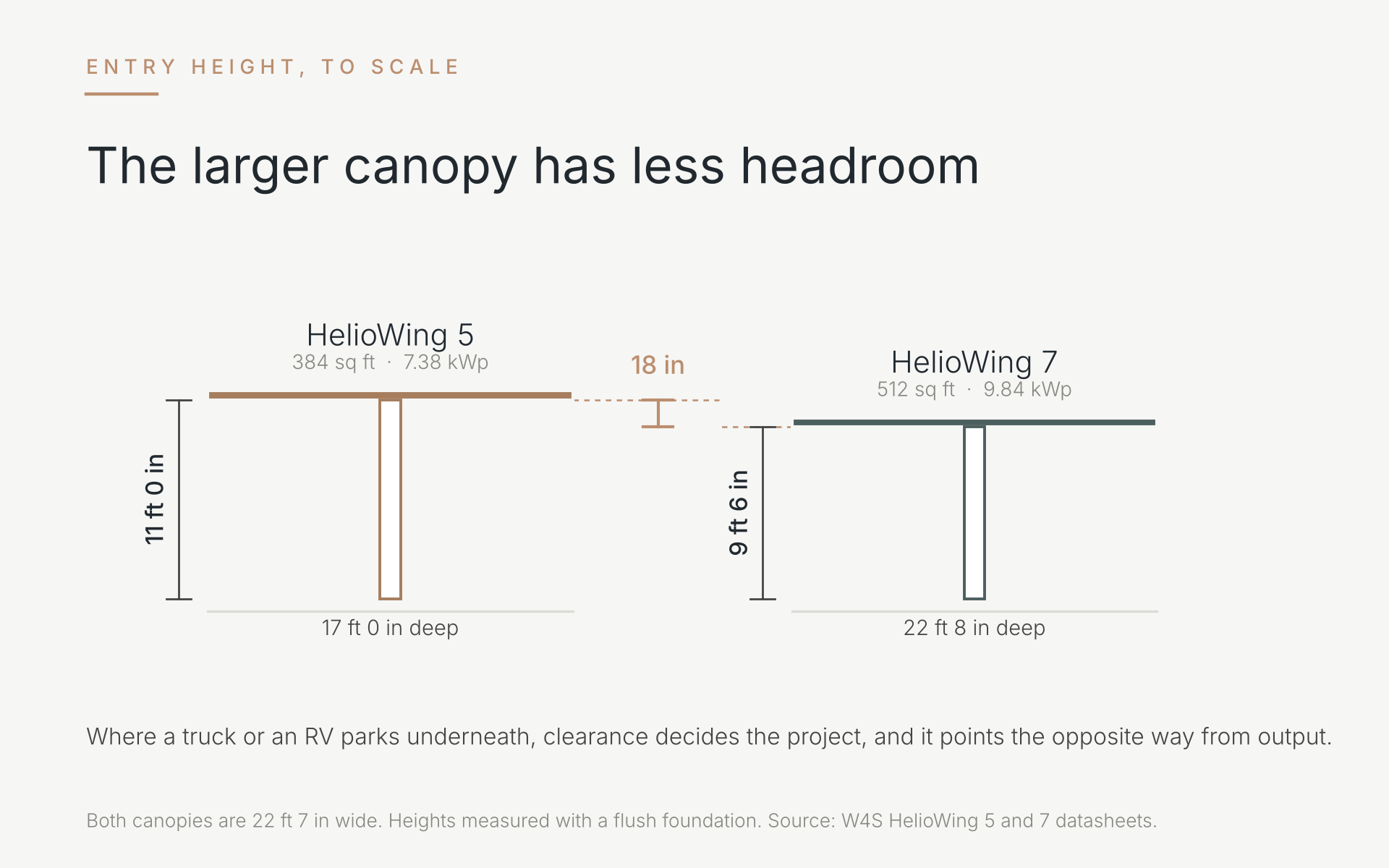
So the smaller unit gives you eighteen more inches of headroom. On a property where a truck with a rack, a tall SUV, a boat or an RV parks under the canopy, that is the specification that decides the project, and it points the opposite direction from raw output. Nobody guesses this from a brochure, and it is a one minute conversation if someone asks the right question early.
Both units carry a 20 year structure warranty and 10 year electrical, with panel output warranted to at least 87.8 percent after twenty years. Both are US made from high strength steel, robotically welded in an ISO 9001 and AISC certified facility, and both ship with a pre approved permitting package covering structure, foundation and the preassembled electrical system.
An independent house is not a house with equipment added. It is a house whose electrical design assumed the equipment from the start.
Which circuits live on backup. Where the conduit runs from canopy to equipment room, and whether that path was roughed in or is now going to be surface mounted across a wall somebody chose carefully. Whether the panel had capacity for a subpanel. Whether the automation knows what to do when production drops, so that loads shed in an order you chose rather than an order you discover. Every one of those costs nothing while the walls are open, which is the same argument we make about everything else that hides inside a wall.
QAV designs energy alongside lighting, shades, network and control rather than as a separate trade arriving late. Under Done at Closing the system is built and tested in our own facility before it reaches the house, which on an energy system means the transfer behavior and the load shed sequence are proven on a bench rather than discovered during the first real test. SUSTAIN is the pillar this work sits in.
Twenty years and more than 700 Colorado homes is mostly an education in which handoffs break. QAV is HTA Certified at the Estate Level, in the top one percent of integrators in North America.
Specifications will not tell you how much light reaches the terrace underneath, how the wing reads against a sky at dusk, whether the column lands where you would actually want to park, or how quiet it is.
QAV is the exclusive World4Solar dealer in Colorado, which means the QAV Experience Center in Centennial is the only place in the state where you can walk under a HelioWing before you own one. Ninety seconds of standing under it answers questions a drawing cannot. Visits are by appointment.
If what you actually want is not independence on ordinary days but certainty on the worst night of the year, that is a different design brief and we have written it up separately in what it takes to keep a Colorado house running through an outage.

Size the system against its worst production week rather than its annual average. In Colorado that stretch is typically four to six overcast days in December or January, and it arrives in the same weeks the house draws the highest loads of the year. A system sized to an annual average produces a large surplus in June and falls short in late December. Sizing to the worst week creates summer surplus that can be directed at flexible loads such as electric vehicle charging, pool equipment or a shop.
Fresh snow helps a bifacial array. Bifacial modules collect reflected light on their lower face, and snow is among the most reflective surfaces in ordinary conditions, considerably brighter than grass, gravel or paving. Cold temperatures also improve photovoltaic cell efficiency rather than reducing it. The HelioWing sits at a fixed ten degree inclination so panels shed accumulation, and its Aptos bifacial modules are rated to 5,400 pascals of snow load.
A home battery will discharge in cold weather but stops accepting charge below a threshold. The HelioWing battery operates down to minus 25 degrees Celsius, which is minus 13 Fahrenheit, but will not charge below minus 15 Celsius, which is 5 degrees Fahrenheit. The pack includes electric heating to manage low temperatures. The practical consequence is a siting decision rather than a limitation on the technology: battery equipment belongs in conditioned or sheltered space rather than an unheated outbuilding at high altitude.
Storage is modular across three tiers. One battery block provides 8.352 kilowatt hours, two provide 16.704, and three, which is the maximum the structure accepts, provide 25.056. Each block pairs a Pylontech US3000C with a US5000, with 95 percent usable depth of discharge and a rated cycle life above 6,000 cycles at room temperature. On larger properties up to six canopies can also operate in parallel as a single system.
The smaller one, which is counterintuitive. Both canopies are 22 feet 7 inches wide, but the HelioWing 5 has an entry height of 11 feet 0 inches while the larger HelioWing 7 has an entry height of 9 feet 6 inches. The HelioWing 5 is 17 feet deep and the HelioWing 7 is 22 feet 8 inches deep with roughly a third more panel area. Where a tall vehicle parks beneath the canopy, clearance points toward the smaller unit even though output points the other way.
The HelioWing is specified for installation below 13,120 feet, which covers every residential property in Colorado. Its ambient operating range runs from minus 25 degrees Celsius to 50 degrees Celsius, with output derating above 40 degrees Celsius, which is 104 Fahrenheit.