

In Highlands Ranch, even a new porch light needs approval. The Highlands Ranch Community Association requires Architectural Review Committee approval for every new or replacement exterior fixture: decorative, security, landscape, accent and permanent eave lighting. Under the community's Residential Improvement Guidelines, the light has to stay within your property lines, decorative fixtures on the house are capped at 500 lumens, security fixtures at 1,000 and fully shielded, nothing mounts higher than ten feet, and motion lights shut off within five minutes.
Most homeowners meet those rules by accident, with a dim fixture by the garage and very little else. We meet them on purpose. A home can be lit beautifully inside these limits: warm light at the entry, the stone and the trees drawn softly out of the dark, paths you can walk without a flashlight, and nothing spilling toward the neighbors. We prepare the fixture details the committee asks for, so the design arrives ready to review.
If you have been in Highlands Ranch for years, your house probably came from the builder with a little of everything: a few ceiling speakers, a basic alarm, a router in the basement. The first residents moved in back in 1981, and plenty of homes have been through a couple of rounds of upgrades since. A renovation is the moment to bring it all onto one system that anyone in the family can use.
If you are new to Highlands Ranch, you have bought into a community that runs on standards, and that is a gift. Start with an honest assessment. We will tell you what to keep, what to replace, and what the exterior plan needs to look like before it goes to the committee.
The south and west edges ask for even more care. Backcountry, the gated community at the southern tip of Highlands Ranch, backs onto a wilderness area the HRCA manages for elk, golden eagles and other wildlife, so outdoor light should be low and quiet. Near the rim-rock landscape that runs toward Daniels Park, where the view stretches from Pikes Peak to the Snowy Range in Wyoming, big windows bring big afternoon sun. Motorized shades keep the glare off the screen and the heat out of the room, then disappear when the mountains turn pink.

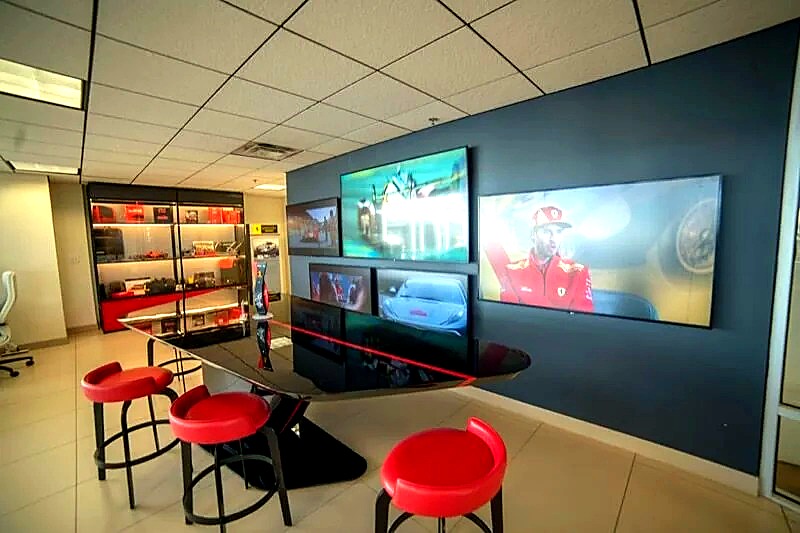
Our work is already here. Ferrari of Denver, Colorado's official Ferrari dealer since 1969, chose QAV for its showroom on East County Line Road in Highlands Ranch, and QAV has been its technology partner ever since: a video wall, sound across the floor, and one simple interface for event nights. Nearby, She's a Brick House in Lone Tree and the Estancia Estate in Centennial show the same care in a home.
Explore the experiences we build, each designed to disappear into the home you already love.
Ferrari of Denver's showroom on East County Line Road in Highlands Ranch, where QAV built the video wall, sound and control. Just east, an award-winning brick custom home in Lone Tree and a light-filled modern estate in Centennial's Estancia.

Yes. Highlands Ranch is close to home for us. Our Experience Center in Centennial is roughly 25 minutes away by C-470, and we are already the technology partner for Ferrari of Denver's showroom in Highlands Ranch.
Every home is custom, so the number follows the home and the life inside it. Many clients start with the foundation, or with one or two things done beautifully, and grow from there over the years. The most accurate answer comes from a short conversation about your house.
Yes. The HRCA requires Architectural Review Committee approval for new or replacement exterior fixtures, including landscape, accent, security and permanent eave lighting, with photos and fixture specifications. We prepare those details as part of the design and plan the lighting to the community's limits from the start, so review is a formality rather than a redesign.
Very good, in fact. Beautiful outdoor lighting is about placement and contrast, not raw brightness, and warm, shielded light reads richer than a bright floodlight. We layer many gentle sources so the entry, the architecture and the landscape all show, while the light stays inside your property.
With motorized shades that are planned into the windows rather than added later. They can lower on their own as the sun comes around, protect floors and screens, and rise again for the evening view toward the foothills. When they are up, you should barely know they are there.