Stand at the top of your own stairs tonight and go down three steps. Notice where you are looking. Not at the bottom landing, and not at your feet. You are looking at the third tread down, roughly where the next two footfalls will land.
Everything that matters in stair lighting happens inside that small moving window.
Now notice what else is in it. In most houses it is a row of recessed step lights set into the side wall at shin height, each one throwing a bright half circle onto the drywall and a bright dot back at you. The wall is lit. The treads are mostly not.
The wall is not the stair. A stair is a stack of horizontal surfaces, and horizontal surfaces are lit from above them or from their own front edge, not from a point in the vertical plane beside them.
Stair lighting design is the practice of putting usable light on the treads and nosings of a staircase from sources placed outside the sightline of someone descending, so the edge of each step reads clearly without a bright source in the eye. It is a separate problem from lighting the room the staircase happens to occupy, and the two are almost always solved with different fixtures.
You do not read a staircase by brightness. You read it by edges. Depth on a stair comes from the contrast between the horizontal tread and the vertical riser, and from the thin line of the nosing where one ends and the other begins. When tread and riser land at the same luminance, the stair flattens into a ramp, and a flattened stair is the one people misjudge.
More light does not fix a flat stair. Direction does.
What a well lit run actually has is a gradient. The front edge of each tread slightly brighter than the back of it. The riser slightly darker than the tread above. The whole flight getting no brighter as you descend, so your eyes never have to re-adapt mid stride. And the brightest surface in view sitting below your eye line rather than inside it.
The recessed side wall step light is the detail everyone knows, and it survives for an honest reason. It is the only stair lighting you can add after the stair exists. Open the drywall, set a box, fish a cable, patch and paint. Every other technique in this article has to be decided while the staircase is still a drawing.
So if your stair is built and your treads are finished, a shielded step light may be the right answer, and it is a far better answer than a ceiling can firing straight down the stairwell.
It is still worth knowing what you are accepting. A fixture centered ten to fourteen inches above the tread puts its brightest output on vertical drywall, which is the one surface nobody walks on. Set on every other riser, it reads as a rhythm of hot scallops rather than as light. And because you descend facing it, the aperture sits close to the line your eye is already traveling.
Within those limits the move is to buy a deeply regressed lens with a solid lower shield, aim the output down and across the treads rather than out into the room, and use fewer of them than the catalog suggests.
The best light on a stair comes from the stair. A linear source concealed in the underside of the nosing, or in a reveal at the back of each tread, means every step lights the one below it. The source is never visible from above or below, because the tread itself is the shield. What you see is a stack of clean horizontal bands and no fixture at all.
Here is the tradeoff, stated plainly. This is a fabrication decision, not a lighting decision. The channel has to exist in the millwork or the steel. The wire has to leave the stringer somewhere specific. The stair shop has to agree to build it, and the lighting designer has to hand them a section drawing before the stair is cut. Retrofitting it is not realistic, and anyone who tells you otherwise has not opened a finished stair.
There is a middle path. A single continuous linear source in one reveal along the wall side, running at tread height for the length of the flight, is easier to detail than a per tread channel and reads as one quiet line rather than a stack of them. It gives up a little nosing definition and gains a great deal of buildability.
A few rules carry most of the result.
Sconces are welcome on a stair if you want the gesture, but they are the decorative layer, and the treads still need a source of their own. A beautiful sconce at eye level is a beautiful glare source.
Pale white oak returns a great deal of what you give it. Walnut, fumed oak, dark stone, and blackened steel return very little. The same fixture, the same detail, and the same driver can produce a tread that looks half as bright, and the instinct is always to add output.
Adding output makes the source visible and the glare worse. It rarely improves footing.
The correction is contrast at the edge. A tighter, brighter line right at the nosing, with the riser behind it deliberately left darker, does more for a foot landing than a flooded tread ever will. This is the same argument that runs through every room in a house, because every material has an opinion about the light you put on it, and a stair is where that opinion is load bearing.
Runners complicate it further. A carpet runner changes reflectance partway across the tread, so a detail proven on a bare oak mockup can go soft once the runner is in. Mock it up with the actual tread material and the actual runner, at the actual angle, before the stair is built.
An open riser removes the riser, which removes half the contrast you were counting on. Light passes between the treads and lands on the wall and floor beyond in a ladder of stripes. That ladder photographs beautifully. It is not navigation.

On an open stair the nosing line has to come from the tread itself or from a grazing source on the wall side, and the under tread channel becomes visible from the room below, which makes the fixture, the finish, and the wire path part of the architecture rather than hidden infrastructure.
The version of the floating stair that is lit from behind the stringer so the treads appear to hover is the most photographed and the least useful. It is sculpture, and sculpture is a fine thing to want. It just needs a second, quieter layer underneath it that actually shows you the edges.
Outside, a stair picks up a second obligation, which is the night itself. DarkSky International and the Illuminating Engineering Society describe responsible outdoor lighting in five words, useful, targeted, low level, controlled, and warm colored, and a flight of exterior steps is one of the easiest places on a property to honor all five at once.
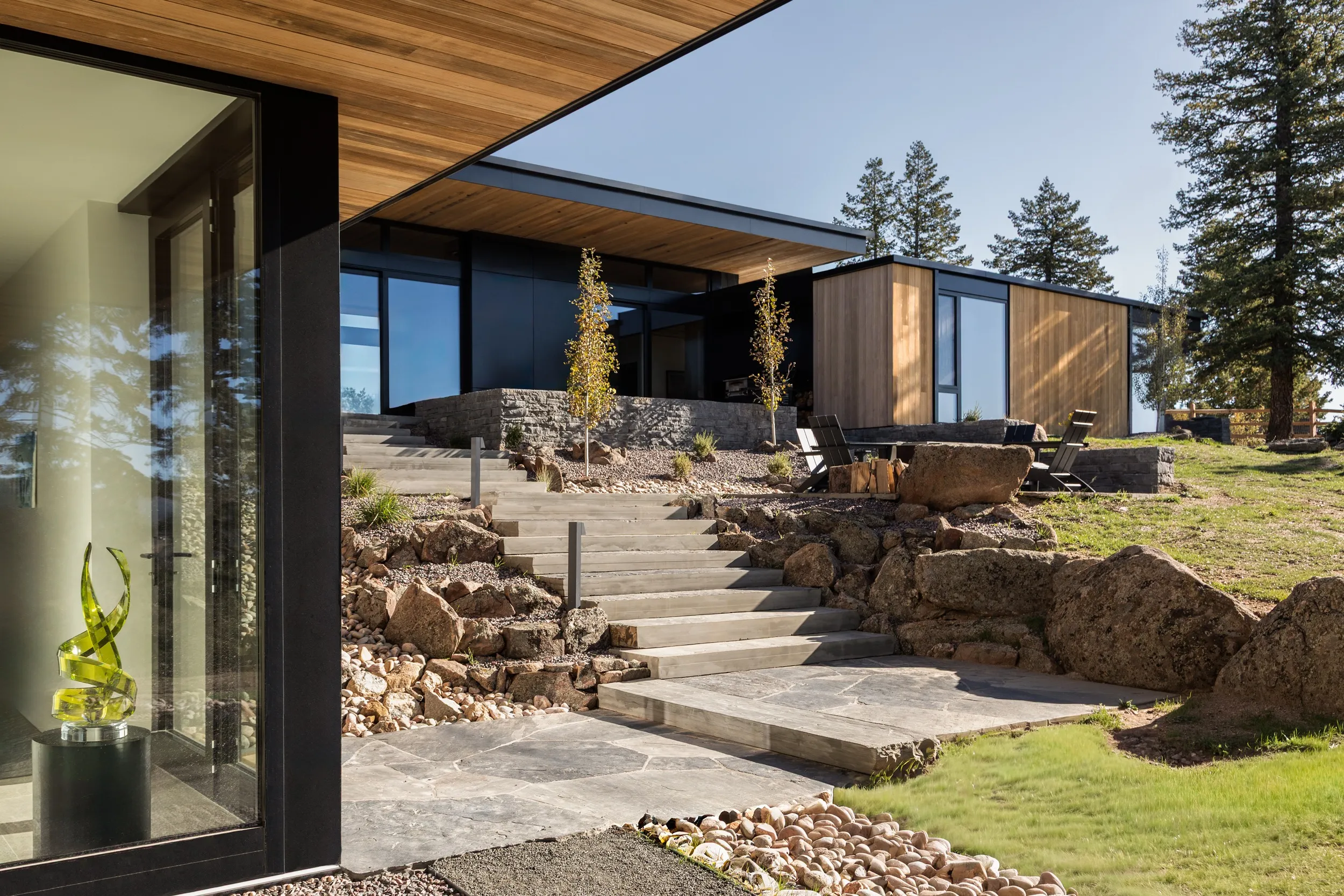
In practice that means light leaving the fixture pointed down, landing on stone, shielded so the source is not visible from the yard or the road, held at the lowest level that still lets the edge read, warm enough to sit comfortably in a dark landscape, and on a schedule that turns it off when the house is asleep. The same restraint that protects the view protects the stair, because a bright unshielded source beside an exterior step is the fastest way to make the step harder to see.
In the foothills and the mountain markets there is a third consideration, which is February. Steps that hold snow need their light arriving from above or from the side. An up facing lens set into a tread vanishes under two inches of accumulation and then announces itself as a melted ring. The same logic governs the rest of the property, where the goal is to light the land rather than the house.
A stair is used at noon and at two in the morning, and it should not look the same at both. The middle of the night pass wants the lowest level the dimming hardware can hold without shimmer, warm, nosing light only, nothing overhead, nothing that wakes anyone up. The noon pass may want nothing at all.
That is a scene, not a switch, which is why the keypad at the top of a stair carries more weight than the one in the hallway. It is the control you reach for in the dark with your hands full, and it is worth choosing with the same care as the handrail. The keypad is the one piece of technology you touch every day.
Low end dimming performance is the real specification on a stair, because the stair is where you ask drivers to run at the bottom of their range for hours at a time. A driver that drops out or flickers at one percent output will do it at the least convenient moment. Occupancy sensing belongs here too, for the same reason. You arrive at a stair with your arms full and you leave it immediately.
A stair detail fails in coordination more often than in concept. The channel is missing from the stair shop drawing. The driver has nowhere to live. The reveal is a sixteenth too shallow for the extrusion. The scene was never programmed because nobody owned both the fixture schedule and the control code.
QAV keeps lighting design fully in house, which matters here for an unglamorous reason. The fixture schedule, the section detail handed to the stair fabricator, and the scene that runs at two in the morning all come from one team. Under Done at Closing, a system is built and tested in QAV's own facility before it reaches the house, so on a stair the dimming curve and the night scene are proven on a bench rather than discovered at move in.
Twenty years of that work, across more than 700 Colorado homes, is mostly an education in what fails. QAV is HTA Certified at the Estate Level, in the top one percent of integrators in North America, and an AIA registered provider teaching CEU courses to architects and designers. That last part is the one that matters on a stair, because the detail has to survive a conversation with the people drawing it.
You will not notice the lighting. That is the point, and it is the hardest thing to sell.

What you will notice is that you stopped looking down. The stair reads as a stair from the landing above, so you know where it turns before you reach it. Nobody opens a phone flashlight at midnight. Guests descend at the same speed they walk on flat ground. And the photographs of the stair finally look like the stair, because the light is on the treads, where the eye expects it.
Stair lighting sits inside the larger discipline of architectural lighting design, where the fixture schedule, the millwork section, and the control scenes get decided in the same conversation rather than in three separate ones. A quarter inch of light at a nosing is easier to feel than to describe, which is the argument for standing on a lit stair before you commit to one. The QAV Experience Center in Centennial is open by appointment.

Stair lighting design is the practice of lighting the treads and nosings of a staircase from sources placed outside the sightline of someone descending, so the edge of each step reads clearly without a visible glare source. Stair lighting design is handled separately from lighting the room a staircase sits in, because the two goals usually call for different fixtures.
Step lights work best when every visible aperture sits below knee height or above shoulder height, with nothing in the band where the eye travels while descending. Measuring step light and sconce heights from the nosing of the tread below each fixture, rather than from the floor, keeps the run climbing with the stair. A deeply regressed lens with a solid lower shield puts light across the treads instead of onto the wall.
Light concealed under the nosing or in a reveal at the back of each tread is the stronger result, because it puts light where feet land and hides the source behind the stair itself. Recessed wall step lights remain useful for one reason: they are the only stair lighting that can be added after a staircase is built, since every tread integrated detail has to be coordinated with the stair fabricator before fabrication begins.
Walnut, fumed oak, dark stone, and blackened steel reflect far less light than pale white oak, so an identical fixture and detail produce a visibly dimmer tread. Adding output usually makes the light source visible and the glare worse rather than improving footing. The better correction is a tighter, brighter line of light right at the nosing with the riser behind it left darker, because the eye reads the edge of a step rather than the overall brightness of the tread.
Ceiling downlights over a stairwell are a poor instrument for lighting a staircase, because they put light on the top of a person's head, cast that person's own shadow onto the tread ahead, and leave the risers unlit. Downlights are better reserved for the landing at the top or bottom of a flight. Light that crosses a tread at a shallow angle rakes the surface and makes the nosing line appear.
Outdoor stair lighting should be aimed downward, shielded so the source is not visible from the yard or the road, held at the lowest level that still lets the edge of each step read, warm in color, and placed on a schedule or sensor that turns it off when it is not needed. Those five qualities, useful, targeted, low level, controlled, and warm colored, are how DarkSky International and the Illuminating Engineering Society describe responsible outdoor lighting. In snow country, light arriving from above or from the side outperforms an up facing lens set into a tread, which disappears under accumulated snow.