

Walk through a finished custom home and count the things that were chosen. The stone. The hardware. The faucets, the hinges, the cabinet pulls. Someone agonized over every one of them.
Then look at the wall beside the door.
In most homes, it is a white plastic rocker switch. It was picked by nobody, from a box of a hundred, because it was the default. And it is the single piece of technology in your house that your hand physically touches every day for the next twenty years.
People assume the phone is the point of a modern home. It is not, and anyone who has lived in one will tell you the same thing.
You do not unlock a phone to turn on a light. You do not hand a guest an app. You reach for the wall, the way humans have always reached for the wall. The interface that actually gets used, thousands of times a year, by you and your family and everyone who visits, is the one your hand finds without looking.
Which makes it strange that it is usually the one thing nobody designed.
This is the functional difference, and it is bigger than it sounds.
A switch controls a circuit. One press, one thing, on or off. In a great room with layered light, that means four or five switches on a wall, and nobody except you knows what any of them do.
A keypad controls intent. One button says Entertain, and the recessed lights come down, the art lighting comes up, the cove warms, and the shades close on the dark. Another says Good Night and the whole floor fades in sequence behind you. The room does something, rather than a fixture doing something.
That is also why a keypad can replace a bank of switches with a single elegant plate. Less wall clutter, not more.
Here is the difference between a keypad that works and a keypad that gets ignored: the buttons say what they do.
Engraved text, cut into the material itself and lit softly from behind, means a houseguest walks up and reads Entertain, Dining, Good Night. No tutorial. No guessing which of five identical paddles does the thing. No calling down the hall to ask.
There is a fair amount of common sense in getting this right, and a fair amount of craft. How many buttons a room actually needs. What each one should be called. What order they belong in, so the hand learns them. What a long press does versus a short one. We start with recommendations based on how the room will be used, then hand it to you to personalize, because the words on your wall should be your words.
This is where it stops being a control and starts being part of the room.
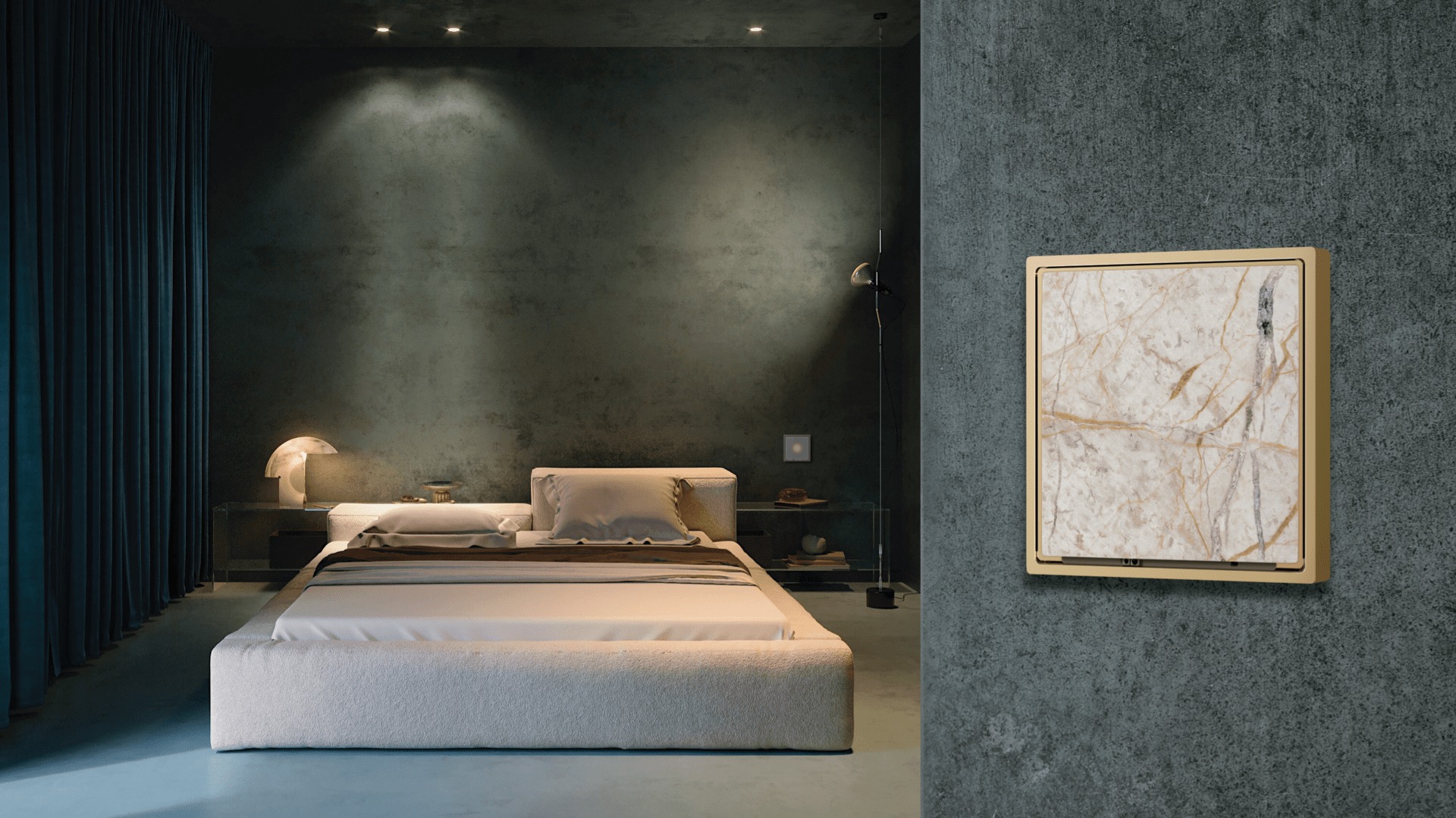
The finest keypads are made the way fine hardware is made. Solid engraved brass from French ateliers, in finishes that patina the way your door hardware does. Stone, marble, and glass from Italy. Leather and sculpted metal from Belgium. Real materials, with weight, that feel like the rest of your home rather than like an appliance stuck to the wall.
They are made to be matched. To your metals, to your wall color, to the finish on the cabinet pulls three feet away. A keypad in unlacquered brass beside unlacquered brass hardware reads as intentional. A white plastic rocker beside it reads as an oversight, because it is one.
Backlighting matters too. The good ones glow just enough to be found in a dark hallway without becoming a light source in your bedroom at midnight.
If you want to go look at these yourself, and you should, these are the makers we work with most.
Crestron builds the Cameo and Horizon keypads, both engravable and backlit, in a wide range of finishes. Lutron makes the Palladiom in architectural metal and the Alisse in glass, both beautiful and both deeply integrated. Basalte, out of Belgium, works in leather, glass, and sculpted metal with a design sensibility all its own. Meljac, in France, hand-makes solid brass plates to order in dozens of finishes. Black Nova builds minimal glass touch panels for a very particular kind of modern room.
Different rooms want different answers, and a single home often uses more than one of these.
The best keypad in the world is wrong if it is in the wrong place.
Standard practice puts the switch wherever the electrician found a stud, at whatever height the code minimum suggests, usually behind the swing of the door. Better practice asks where your hand actually falls when you walk into the room, which side you approach from, and whether that wall is going to have a console table against it.
Same question at the bedside, in the pantry, at the top and bottom of the stairs. It costs nothing to decide during design, and it costs a wall repair to change afterward.
A production rocker switch costs a few dollars. That is the number you are comparing against, and it is why this feels like an extravagance right up until you touch one.
Here is roughly how the range works, per location.
Around $200 to $300. A quality engraved, backlit keypad from a serious control manufacturer. Real scene control, readable labels, and a finish selection that works in a good room. This is where most homes should start.
Around $450 to $650. Glass and metal. Heavier, more refined, and the point where the keypad starts reading as part of the architecture rather than as a control.
Around $800 to $1,300. European and premium. Hand-finished plates, deeper material choices, and the kind of tactile quality you notice the first time you press one.
Around $2,000 and up. Twenty-four karat gold, stone, and the rarest finishes. A small number of locations in a small number of homes, and unmistakable when you see them.
Two things worth knowing before you react to those numbers. First, a keypad often replaces three or four switches, so you are not comparing one to one. Second, most homes have a handful of locations where this actually matters. The entry, the great room, the primary suite, the bedside, the kitchen. The pantry and the mechanical room can stay ordinary, and should. Spending everywhere is how budgets get wasted. Spending where your hand lands is how a home feels considered.
Keypads are not a finish selection you make at the end with the paint colors. They are wired differently than switches, they need a control system behind them to be worth anything, and the scenes they run have to exist in a lighting plan before anyone programs them.
Decide during design and every option is open, including where they go. Decide after drywall and you are choosing from what fits the boxes an electrician already placed.
It is the same story as the rest of the ceiling, which we wrote about in Lighting Design or Lighting Layout?
We call it that, and it is not a marketing line. A keypad occupies the same visual role as a piece of hardware or a light fixture: small, repeated throughout the house, and touched constantly. Get it right and guests notice without being able to say why. Get it wrong and it is the one cheap thing in an expensive room.
Come stand in front of a few at our Experience Center in Centennial. Press them. Feel the weight. Ten seconds is usually all it takes, and it is the fastest way to understand what ILLUMINATE means when we say the technology should feel like part of your home.

A switch controls a circuit, so one press turns one thing on or off. A keypad controls intent, so one press can set an entire scene: lights down, art lighting up, shades closed. A keypad also replaces several switches with one elegant plate.
Roughly $200 to $300 for a quality engraved, backlit keypad from a serious control manufacturer. Glass and metal run about $450 to $650. European and premium hand-finished plates run about $800 to $1,300. Twenty-four karat gold, stone, and the rarest finishes reach $2,000 and beyond.
No, and you should not. Most homes have a handful of locations where it matters: the entry, the great room, the primary suite, the bedside, the kitchen. The pantry and the mechanical room can stay ordinary.
Because a guest can read it. Engraved, softly backlit labels mean anyone can walk up and press Entertain or Good Night without a tutorial. We recommend a starting set based on how the room is used, then you personalize the wording from there.
Solid engraved brass from French ateliers, stone, marble, and glass from Italy, and leather and sculpted metal from Belgium. The makers we work with most are Crestron, Lutron, Basalte, Meljac, and Black Nova.
During design. Keypads wire differently than switches, they need a control system behind them, and the scenes they run have to exist in a lighting plan first. After drywall, you are choosing from whatever fits the boxes the electrician already placed.